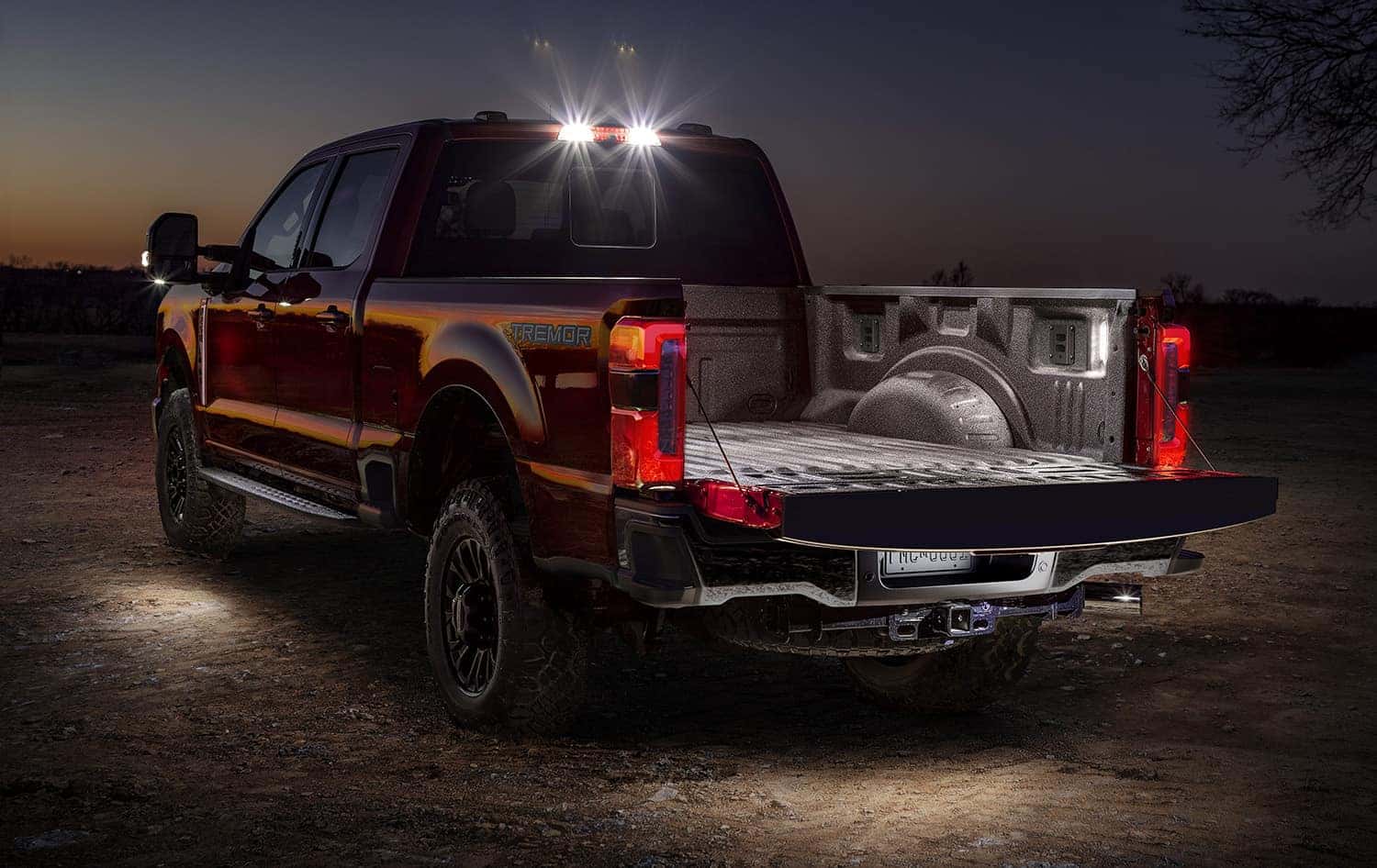
The F-250 vs F-350: Heavy-Duty Ford Truck Showdown comes down to how much weight sits on the truck versus behind it, and Toliver Ford Mineola helps drivers across Mineola, Grand Saline, and Canton, Texas, land on the right answer. A hay hauler running coastal Bermuda pastures off FM 49 needs something different from a family towing a fifth-wheel to Lake Fork every weekend. Both trucks share the Super Duty® frame, both offer the same four engines, and the gap between them is narrower than the numbers suggest.
| Spec | F-250® SRW | F-350® SRW | F-350® DRW |
|---|---|---|---|
| Max conventional towing | 22,000 pounds | 25,000 pounds | 27,000 pounds |
| Max gooseneck / fifth-wheel | 23,000 pounds | 27,600 pounds | 38,000 pounds |
| Max payload | ~4,300 pounds | ~4,700 pounds | 8,000 pounds |
| Rear wheels | Single | Single | Dual |
| Best suited to | Daily driving with weekend towing | Heavier trailers, same daily footprint | Commercial hauling and big fifth-wheels |
Those top numbers only show up on trucks built to hit them. Cab style, bed length, axle ratio, and even tire choice shift the rating, sometimes by thousands of pounds, so the sticker on the door jamb tells you what the truck in front of you can actually do.
Suspension and rear axle rating, mostly. The Ford F-350 carries stiffer rear springs and a higher gross vehicle weight rating, which is what lets it accept more weight in the bed and more tongue weight on the hitch. Park them side by side, and the single-rear-wheel versions look nearly identical.
The bigger fork in the road is single rear wheel versus dual. An F-350 DRW adds two rear tires and a wider stance, which transforms payload capacity but also widens the truck enough to matter in a downtown Mineola parking space or a narrow gate on a Wood County ranch road. Ride quality is the other trade: unloaded, the F-350's firmer rear end is noticeable on the rough stretches of US-69 north toward Quitman. Loaded, that same stiffness is the entire point.
Four engines, all paired with a 10-speed TorqShift® automatic transmission, and both trucks can be ordered with any of them.
Torque is what pulls a loaded trailer up a grade, and both Power Stroke® versions make peak torque at just 1,600 rpm. That low-rpm delivery is why diesel owners hauling cattle to a sale barn or a skid steer out toward Grand Saline rarely regret the upgrade. The 7.3L gas V8 is the value play if you tow monthly rather than weekly, and it carries the highest payload of any gas configuration.
For work, count the weight going in the bed before you look at trailer ratings. Welding rigs, service bodies, and dump inserts eat payload fast, and that is where the F-350 DRW's 8,000-lb. ceiling separates itself. Contractors running crews between Van Zandt County job sites usually land here.
For RVs and trailers, tongue weight decides it. A large fifth-wheel headed to the RV hookups at Mineola Civic Center or a campground near First Monday Trade Days in Canton can put 3,000 lbs. or more on the hitch, which pushes past what an F-250 handles comfortably. Gooseneck stock trailers follow the same logic.
For daily driving, the Ford F-250 wins on livability. It parks more easily at the Main Street Farmer's Market, rides better empty, and still tows more than most owners ever ask of it. Buy the truck that fits your heaviest realistic load, not your heaviest imagined one.
Upgrade when your loads live near the F-250's ceiling instead of under it. That is the whole test, and a few situations make it obvious:
If two or more of those describe your week, step up to the F-350, and consider the dual-rear-wheel version if the heaviest weight rides in the bed rather than behind the bumper.
The single-rear-wheel F-350 drives almost identically, since the width and turning radius match the F-250. Only the dual-rear-wheel version feels different, because the wider rear track changes how the truck fits in parking spaces and gates.
Yes, substantially. The Power Stroke® diesel's 1,050 lb.-ft. of torque raises ratings on both trucks, but the F-350 DRW pairs it with a higher axle rating, which is what unlocks gooseneck figures reaching 38,000 lbs.
Yes. The fully boxed high-strength steel frame and commercial-grade axles are engineered for repeated heavy loads rather than occasional ones, which is why these trucks hold up under work-truck duty cycles. iSeeCars ranks the Super Duty F-250 among the longest-lasting vehicles on the road.*
The honest answer to the F-250 vs F-350: Heavy-Duty Ford Truck Showdown is that both trucks are more capable than most buyers need, and the right one depends on the heaviest load you actually pull. Toliver Ford Mineola stocks both for drivers in Mineola, Grand Saline, and Canton, TX. Bring your trailer weights and bed setup, and our team will match you to the axle, engine, and cab combination that handles it without paying for capacity you will never use. Contact us to get started!